2025 E-commerce Security: 3 Critical Updates to Protect US Data
The 2025 e-commerce platform security landscape necessitates a sharp focus on three critical updates to effectively safeguard US customer data, aiming to prevent a significant 70% of potential breaches.
The digital storefronts of today are under constant siege. In an era where data is the new currency, ensuring robust protection for customer information has moved from a best practice to an absolute imperative. The 2025 E-commerce Platform Security Landscape: 3 Critical Updates to Protect US Customer Data and Avoid 70% of Breaches is not merely a forecast but a call to action for businesses operating in the United States. As cyber threats evolve with unprecedented speed, so too must our defenses, requiring a strategic pivot towards advanced, proactive security measures.
The Evolving Threat Landscape: Why 2025 Demands More
The digital world is a dynamic battleground, and e-commerce platforms are prime targets. In 2025, the sophistication of cyberattacks will reach new heights, driven by advancements in AI, machine learning, and increasingly organized cybercriminal syndicates. Traditional perimeter defenses are no longer sufficient to protect the vast amounts of sensitive US customer data processed daily. This section explores the key drivers behind this escalating threat and why a business-as-usual approach is fraught with peril.
Sophisticated Attack Vectors
Cybercriminals are constantly refining their methodologies, moving beyond simple phishing attempts to highly targeted and complex assaults. These include advanced persistent threats (APTs), supply chain attacks, and sophisticated ransomware that can cripple operations and compromise data at an alarming rate. Businesses must understand these evolving tactics to build resilient defenses.
- AI-Powered Phishing: More convincing and personalized phishing attempts, making detection harder for employees.
- Supply Chain Vulnerabilities: Exploiting weaknesses in third-party vendors and partners to gain access to primary systems.
- Zero-Day Exploits: Attacks leveraging unknown software vulnerabilities before patches are available.
The sheer volume of data handled by e-commerce platforms, from personal identifiable information (PII) to payment card details, makes them irresistible to attackers. A single breach can lead to devastating financial losses, irreparable reputational damage, and severe legal repercussions under US data privacy laws. Therefore, understanding the nuances of the 2025 threat landscape is the first step toward effective mitigation and safeguarding consumer trust.
Critical Update 1: AI-Powered Behavioral Analytics and Anomaly Detection
One of the most significant shifts in e-commerce security for 2025 will be the widespread adoption of AI-powered behavioral analytics and anomaly detection. This isn’t just about identifying known threats; it’s about predicting and preventing novel attacks by recognizing deviations from normal user and system behavior. Traditional rule-based security systems are often reactive, responding only after a breach has occurred or a known threat signature is identified. AI, however, offers a proactive stance.
By continuously monitoring user interactions, transaction patterns, and system logs, AI algorithms can establish a baseline of normal activity. Any departure from this baseline, no matter how subtle, triggers an alert. This could include unusual login times, atypical purchase volumes, or data access patterns that don’t align with a user’s historical behavior. Implementing such systems requires significant investment in data infrastructure and machine learning capabilities, but the return on investment in terms of breach prevention is substantial.
Proactive Threat Identification
AI-driven systems excel at identifying anomalies that human analysts might miss. They can process vast quantities of data in real-time, learning and adapting to new threats as they emerge. This capability is crucial for identifying sophisticated attacks that mimic legitimate user activity.
- Real-time Monitoring: Continuous oversight of all platform activities, flagging suspicious events instantly.
- Pattern Recognition: Identifying complex attack patterns that evade traditional security protocols.
- Adaptive Learning: Systems that learn from new data, improving their detection accuracy over time.
The integration of AI into security operations allows e-commerce platforms to move beyond mere detection to true prevention, intercepting threats before they can inflict damage. This proactive approach is foundational to protecting US customer data in the highly volatile 2025 security environment, contributing significantly to the goal of avoiding 70% of breaches.
Critical Update 2: Zero-Trust Architecture Implementation Across All Touchpoints
The second critical update for 2025 is the full adoption of a Zero-Trust Architecture (ZTA) across all e-commerce platform touchpoints. The traditional security model, which assumes that everything inside the corporate network is trustworthy, is fundamentally flawed in today’s distributed and cloud-centric environments. Zero Trust operates on the principle of “never trust, always verify,” requiring strict identity verification for every person and device attempting to access resources, regardless of whether they are inside or outside the network perimeter.
For e-commerce, this means applying stringent access controls to customer accounts, administrative interfaces, payment gateways, and even internal systems that handle sensitive data. Each access request is authenticated, authorized, and continuously validated based on context, such as user identity, device health, location, and the sensitivity of the data being accessed. This significantly limits the potential damage from compromised credentials or insider threats, as even authenticated users are granted only the minimum necessary access.
Micro-segmentation and Least Privilege
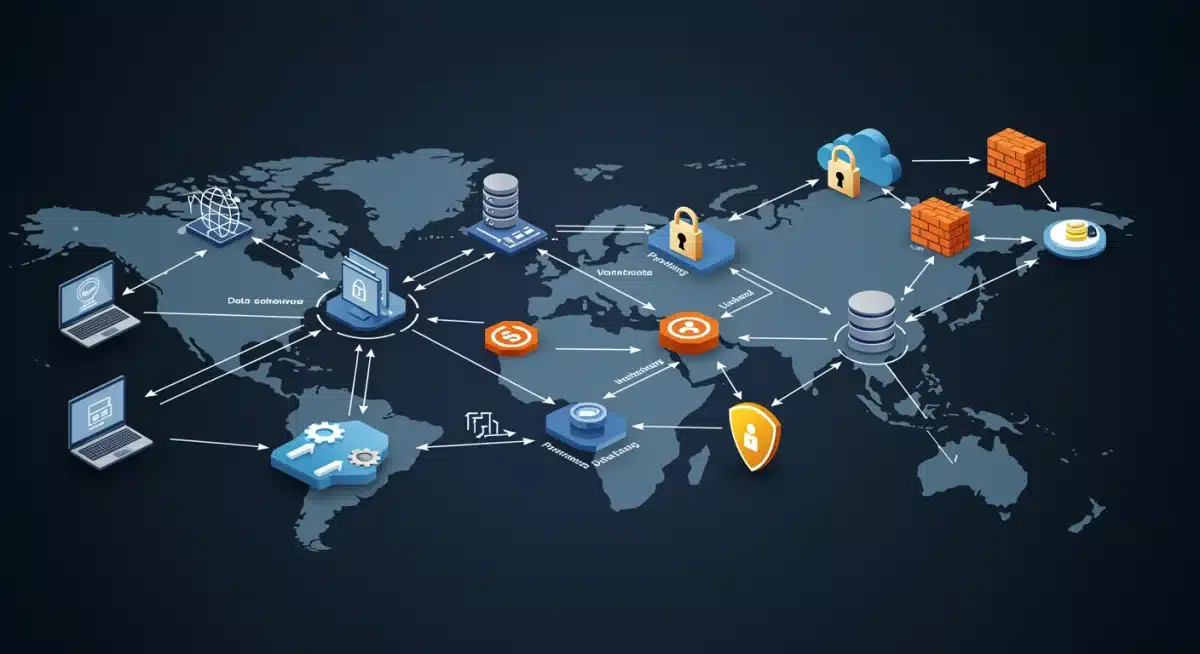
Key components of ZTA include micro-segmentation, which divides the network into small, isolated segments, and the principle of least privilege, ensuring users and applications only have access to the resources absolutely necessary for their function. This granular control minimizes the attack surface and prevents lateral movement of attackers within the system.
- Identity Verification: Robust multi-factor authentication (MFA) and continuous authentication for all users.
- Device Posture Checks: Verifying the security health of devices before granting access.
- Context-Based Policies: Dynamic access policies that adapt based on real-time risk assessments.
Implementing a comprehensive ZTA is a complex undertaking, requiring a cultural shift in security thinking and significant technological overhaul. However, its effectiveness in preventing unauthorized access and containing breaches makes it an indispensable security update for e-commerce platforms seeking to protect US customer data effectively in 2025 and achieve substantial breach reduction targets.
Critical Update 3: Enhanced Data Encryption and Tokenization Standards
The third critical update revolves around elevating data encryption and tokenization standards for all sensitive US customer data. While encryption is not new, the 2025 landscape demands stronger algorithms, ubiquitous application, and advanced key management practices. Furthermore, tokenization, particularly for payment card data, will become the default standard, rendering sensitive information useless even if a breach occurs.
End-to-end encryption, from the moment data is collected to its storage and processing, is paramount. This includes data in transit (using TLS 1.3 or higher), data at rest (using AES-256 or stronger), and data in use (leveraging homomorphic encryption or confidential computing where feasible). For payment processing, tokenization replaces actual card numbers with unique, non-sensitive tokens. If a tokenized database is compromised, attackers gain no valuable payment information, as the original data is stored securely offline or with a trusted third-party tokenization provider.
Advanced Key Management and Quantum Security
The management of encryption keys is as crucial as the encryption itself. 2025 will see an emphasis on hardware security modules (HSMs) and robust key rotation policies to prevent key compromise. Additionally, with the looming threat of quantum computing, e-commerce platforms must begin exploring and integrating quantum-resistant cryptography to future-proof their data protection strategies.
- Ubiquitous Encryption: Encrypting all sensitive data across its entire lifecycle.
- Payment Tokenization: Replacing sensitive payment data with non-exploitable tokens.
- Post-Quantum Cryptography Readiness: Preparing for future cryptographic challenges posed by quantum computing.
By implementing these enhanced encryption and tokenization standards, e-commerce platforms can create multiple layers of defense, ensuring that even if other security measures fail, the actual sensitive data remains protected. This update is vital for maintaining customer trust and compliance with evolving data protection regulations in the US, drastically reducing the impact of potential breaches.
Integrating Compliance and Regulatory Frameworks
Beyond technological updates, the 2025 e-commerce security landscape also necessitates a deep integration of compliance and regulatory frameworks into security strategies. In the US, the patchwork of state-level data privacy laws, such as CCPA/CPRA, and sector-specific regulations like HIPAA (for health-related e-commerce) and PCI DSS (for payment processing), creates a complex compliance environment. E-commerce platforms must not only meet these requirements but also build security programs that anticipate future regulatory changes.
A proactive approach to compliance means embedding privacy-by-design principles into platform development and operational processes. This includes conducting regular privacy impact assessments, maintaining transparent data handling policies, and ensuring customers have clear control over their personal data. Furthermore, robust incident response plans that align with breach notification laws are crucial for minimizing the fallout from any security event.
Unified Compliance Management
Managing multiple compliance requirements can be challenging. Platforms should invest in unified compliance management solutions that automate auditing, reporting, and policy enforcement across various regulatory standards. This streamlines the compliance process and reduces the risk of non-compliance fines and legal action.
- Privacy-by-Design: Integrating privacy considerations from the outset of system development.
- Regular Audits: Conducting frequent security and compliance audits to identify and remediate vulnerabilities.
- Transparent Data Practices: Clearly communicating data collection, usage, and sharing policies to customers.
By treating compliance as an integral part of security, e-commerce platforms can build a more trustworthy and resilient operation. This strategic alignment not only protects customer data but also enhances brand reputation and fosters long-term customer loyalty, which are invaluable assets in the competitive 2025 market.
Building a Culture of Security: Human Element in Protection
While technological advancements are critical, the human element remains a cornerstone of effective e-commerce security. In 2025, fostering a robust culture of security within an organization will be as important as any technological update. Employees, from developers to customer service representatives, are often the first line of defense, but they can also be the weakest link if not properly trained and engaged.
Comprehensive and ongoing security awareness training is essential. This training should cover topics like identifying phishing attempts, safe browsing practices, password hygiene, and the importance of reporting suspicious activities. Beyond basic training, platforms should empower employees to take ownership of security, making it a shared responsibility rather than solely the domain of IT or cybersecurity teams. Regular simulations, such as mock phishing campaigns, can further reinforce learning and test preparedness.
Empowering Employees as Security Advocates
Creating a security-conscious culture involves more than just rules; it requires empowering employees to become active participants in protecting the platform. This includes providing accessible channels for reporting concerns, celebrating security successes, and integrating security metrics into performance reviews where appropriate.
- Continuous Training: Regular and updated security awareness programs for all staff.
- Phishing Simulations: Realistic exercises to improve employee vigilance against social engineering.
- Clear Reporting Channels: Easy and confidential ways for employees to report security concerns.
A strong security culture minimizes internal vulnerabilities and ensures that security policies are consistently followed. By investing in their human capital, e-commerce platforms can significantly strengthen their overall security posture, reinforcing the technological measures designed to protect US customer data and achieve ambitious breach prevention goals.
The Path Forward: Strategic Investments for 2025 Security
As we look to 2025, the imperative for e-commerce platforms to bolster their security measures cannot be overstated. The digital economy relies on trust, and that trust is built on the assurance that customer data is safe. The three critical updates – AI-powered behavioral analytics, Zero-Trust Architecture, and enhanced encryption/tokenization – represent strategic investments that will collectively fortify defenses against the most sophisticated cyber threats. These are not merely upgrades but fundamental shifts in how security is conceived and implemented.
Beyond these core technological shifts, platforms must also cultivate a deep understanding of the regulatory landscape and embed privacy principles into their core operations. The human element, through continuous training and a strong security culture, acts as a crucial complement to technological defenses. By integrating these elements, e-commerce businesses can not only protect US customer data more effectively but also build a resilient and trustworthy foundation for future growth in an increasingly digital world.
The goal of avoiding 70% of breaches in 2025 is ambitious but achievable with a concerted, multi-faceted approach. This requires proactive planning, continuous adaptation, and a commitment to staying ahead of evolving cyber threats. The future of e-commerce security is not about reacting to breaches but about preventing them before they occur, ensuring customer confidence and operational integrity.
| Key Update | Brief Description |
|---|---|
| AI Behavioral Analytics | Proactive identification of unusual user and system behavior to prevent novel attacks. |
| Zero-Trust Architecture | Strict identity verification and least privilege access for every interaction, internal or external. |
| Enhanced Encryption & Tokenization | Ubiquitous, stronger encryption and tokenization for sensitive data, including payment information. |
| Compliance Integration | Embedding privacy-by-design and regulatory alignment into all security operations. |
Frequently Asked Questions About 2025 E-commerce Security
These three updates—AI-powered behavioral analytics, Zero-Trust Architecture, and enhanced encryption/tokenization—are critical because they address the evolving sophistication of cyber threats. They enable proactive threat detection, minimize breach impact by restricting access, and render compromised data useless, collectively preventing a significant percentage of potential breaches.
AI-powered behavioral analytics establishes a baseline of normal user and system activity. By continuously monitoring and identifying any deviations from this baseline in real-time, it can detect and flag suspicious or anomalous behaviors that indicate a potential attack, even if it’s a previously unknown threat, preventing breaches before they fully materialize.
Zero-Trust Architecture (ZTA) operates on the principle of “never trust, always verify.” It requires strict verification for every access attempt, regardless of location. For US customer data, ZTA ensures that even if credentials are compromised, unauthorized access is prevented, and attackers cannot move laterally within the system, severely limiting potential data exposure.
Enhanced encryption and tokenization ensure that sensitive data, particularly payment information, remains protected even if a breach occurs. Encryption scrambles data, making it unreadable without the correct key, while tokenization replaces actual sensitive data with non-sensitive substitutes. This dual approach significantly reduces the value of stolen data to cybercriminals.
Achieving a 70% breach avoidance rate requires a multi-faceted strategy. This includes implementing the three critical updates, integrating robust compliance frameworks, and fostering a strong security culture through continuous employee training. Proactive planning, continuous adaptation, and strategic investments in advanced security technologies are key to meeting this ambitious goal.
Conclusion
The journey towards a more secure e-commerce landscape in 2025 is both challenging and essential. By prioritizing AI-powered behavioral analytics, implementing a comprehensive Zero-Trust Architecture, and elevating data encryption and tokenization standards, US e-commerce platforms can significantly fortify their defenses. These critical updates, coupled with a proactive approach to compliance and a strong security culture, form the bedrock of a resilient security posture capable of protecting sensitive customer data and aiming to avoid a substantial majority of potential breaches. The commitment to these advancements will not only safeguard businesses but also reinforce the trust that underpins the entire digital economy.