Optimizing Pricing Strategies with Data Analytics for 5% Higher Profit Margins

Integrating advanced data analytics into pricing strategies is crucial for businesses aiming to achieve at least a 5% increase in profit margins by 2025, enabling precise market positioning and revenue optimization.
In today’s highly competitive e-commerce landscape, businesses are constantly seeking innovative ways to boost their bottom line. One of the most impactful yet often underutilized levers is pricing. By leveraging advanced data analytics, companies can move beyond guesswork and implement sophisticated strategies for optimizing pricing strategies with data analytics: achieving 5% higher profit margins in 2025. This transformation isn’t just about minor adjustments; it’s about a fundamental shift in how value is perceived and exchanged, ultimately driving significant financial gains.
The foundational role of data in pricing decisions
Understanding the critical importance of data is the first step toward revolutionizing your pricing strategy. In a world saturated with information, raw data alone holds little value. Its true power emerges when it is collected, processed, and analyzed to reveal actionable insights. For pricing, this means moving beyond simple cost-plus models or competitor-matching to a nuanced understanding of market dynamics, customer behavior, and product value.
Data analytics provides the tools to dissect complex market signals, allowing businesses to identify optimal price points that maximize profitability without alienating customers. This data-driven approach ensures that every pricing decision is backed by evidence, reducing risk and increasing the likelihood of success. It’s no longer sufficient to guess what customers will pay; instead, businesses must know.
Collecting the right data for effective pricing
The quality of your pricing strategy is directly tied to the quality of your data. To make informed decisions, you need access to a diverse range of data points. This includes internal sales data, customer demographics, website traffic patterns, and external market intelligence.
- Internal Sales Data: Transaction histories, purchase frequency, average order value, and product margins.
- Customer Behavior Data: Browsing patterns, click-through rates, conversion rates, and abandonment rates.
- Market Data: Competitor pricing, industry trends, economic indicators, and supply chain costs.
- Product Data: Inventory levels, product lifecycle, and feature sets.
By systematically gathering and integrating these different types of data, businesses can build a comprehensive picture that informs every aspect of their pricing strategy. This holistic view is essential for developing models that accurately predict customer responses to price changes and identify opportunities for optimization.
Leveraging predictive analytics for future pricing
Predictive analytics takes historical data and applies statistical algorithms and machine learning techniques to forecast future trends and behaviors. In the realm of pricing, this means anticipating how demand will shift, what competitors might do, and how different price points will impact sales volumes and revenue. This forward-looking perspective is invaluable for proactive pricing adjustments.
Instead of reacting to market changes, businesses can use predictive models to get ahead of them. This allows for dynamic pricing strategies that adapt in real-time to evolving conditions, ensuring that products are always priced optimally. The ability to predict customer elasticity and market saturation can be a significant competitive advantage.
For example, an e-commerce store might use predictive analytics to determine the optimal discount percentage for a seasonal sale, considering historical sales data, current inventory levels, and anticipated customer demand. This precision minimizes lost revenue from over-discounting while maximizing sales during peak periods. Without predictive models, such decisions would be based on intuition, which is often less reliable.
Dynamic pricing models: flexibility and responsiveness
Dynamic pricing, often referred to as surge pricing or demand pricing, is a strategy where prices for products or services fluctuate based on real-time market conditions. This approach is heavily reliant on robust data analytics capabilities, as it requires continuous monitoring and rapid adjustments. The goal is to optimize revenue and profit by charging customers the maximum price they are willing to pay at any given moment.
The effectiveness of dynamic pricing lies in its ability to respond to various factors, including time of day, day of week, competitor prices, demand levels, and even individual customer characteristics. Airlines and ride-sharing services are classic examples of industries that have successfully implemented dynamic pricing, but its application is expanding rapidly across e-commerce and retail.
Implementing dynamic pricing with data analytics
- Real-time data feeds: Integrating live data streams from various sources to inform pricing algorithms.
- Machine learning algorithms: Developing models that learn from pricing outcomes and adapt strategies over time.
- Automated pricing tools: Utilizing software that can execute price changes without manual intervention.
- A/B testing: Continuously testing different price points and strategies to identify the most effective ones.
While dynamic pricing offers immense potential for profit optimization, it also requires careful consideration of customer perception. Transparency and clear communication can help mitigate any negative reactions to fluctuating prices, ensuring long-term customer loyalty alongside enhanced profitability. Striking the right balance between profit maximization and customer satisfaction is key.
Customer segmentation and personalized pricing
Not all customers are created equal, and neither should their prices be. Customer segmentation involves dividing your customer base into distinct groups based on shared characteristics, behaviors, or needs. Once segments are identified, businesses can tailor pricing strategies to each group, offering personalized deals or pricing tiers that resonate more effectively with their specific value perceptions. This approach is a powerful way to maximize revenue from diverse customer bases.
Data analytics plays a pivotal role here, enabling businesses to identify meaningful segments through sophisticated clustering algorithms and predictive modeling. Factors such as purchase history, browsing behavior, demographic information, and even geographic location can be used to create highly granular segments, each with its own optimal pricing strategy. This level of personalization moves beyond mass-market pricing and taps into individual willingness to pay.
For instance, a loyal customer might receive a special discount, while a new customer might be offered an introductory price to encourage their first purchase. Similarly, customers who frequently purchase high-margin items might be targeted with premium pricing for exclusive products. This nuanced approach ensures that every customer interaction is optimized for both satisfaction and profitability, contributing significantly to the overall goal of increased profit margins.
Measuring impact and continuous optimization
Implementing data-driven pricing strategies is not a one-time project; it is an ongoing process of measurement, analysis, and refinement. To truly achieve and sustain a 5% higher profit margin, businesses must establish robust mechanisms for tracking the impact of their pricing decisions and continuously optimizing their strategies. This involves setting clear key performance indicators (KPIs) and regularly reviewing performance against these metrics.
Key metrics to monitor include gross profit margin, net profit margin, sales volume, customer acquisition cost, customer lifetime value, and price elasticity of demand. By analyzing these metrics in conjunction with pricing changes, businesses can gain valuable insights into what works and what doesn’t. This iterative process allows for continuous learning and adaptation, ensuring that pricing strategies remain effective in a dynamic market environment.
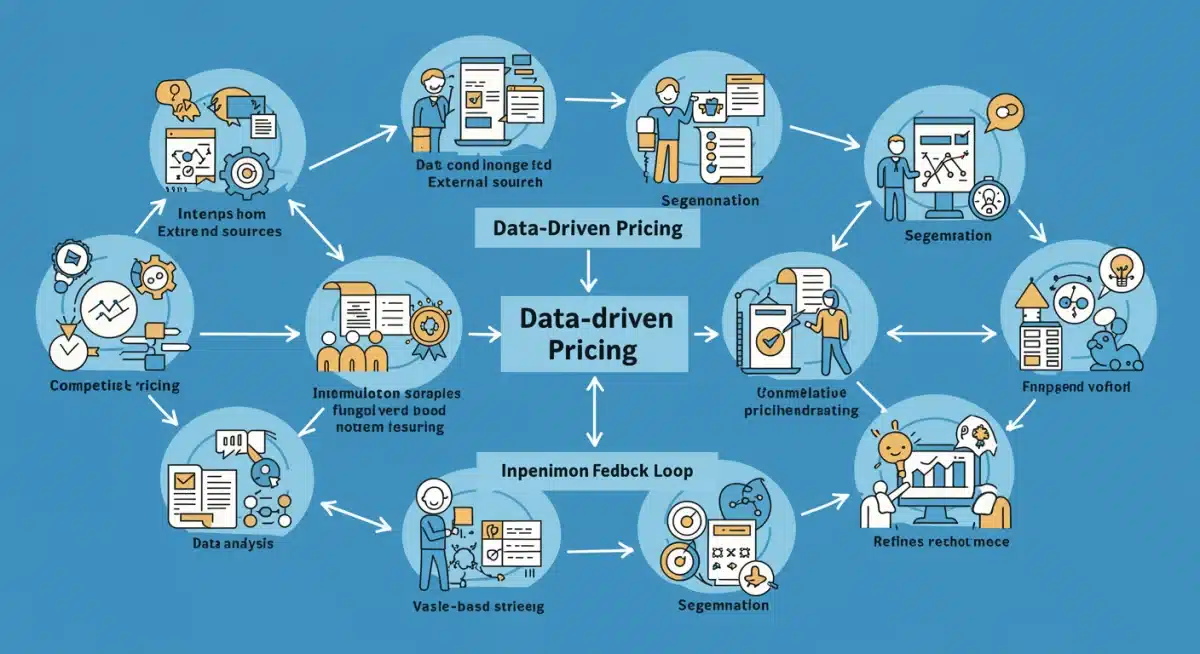
Furthermore, A/B testing is an indispensable tool for continuous optimization. By running controlled experiments with different price points or pricing models, businesses can scientifically determine which strategies yield the best results. This empirical approach eliminates guesswork and provides concrete data to support future pricing adjustments, solidifying the path towards sustained profitability and competitive advantage. Regular audits of pricing models and data sources are also crucial to maintain accuracy and relevance.
Overcoming challenges in data-driven pricing
While the benefits of data-driven pricing are clear, implementing these strategies can present several challenges. These include data quality issues, the complexity of analytical models, the need for skilled personnel, and potential resistance from internal stakeholders or customers. Addressing these challenges proactively is essential for successful adoption and sustained impact.
Data quality is paramount; incomplete, inaccurate, or inconsistent data can lead to flawed insights and suboptimal pricing decisions. Investing in data governance, cleansing processes, and reliable data integration tools is crucial. Moreover, the development and maintenance of sophisticated analytical models require expertise in data science and machine learning. Businesses may need to hire specialized talent or partner with external consultants to bridge this skill gap.
Key challenges and solutions
- Data Silos: Integrate data from various departments into a unified platform for a holistic view.
- Lack of Analytical Talent: Invest in training existing staff or recruit data scientists and analysts.
- System Integration: Ensure seamless integration between pricing software, ERP, CRM, and e-commerce platforms.
- Change Management: Communicate the benefits of data-driven pricing to stakeholders and address concerns to foster adoption.
Successfully navigating these challenges requires a strategic approach, significant investment in technology and human capital, and a commitment to continuous improvement. However, the potential for increased profit margins and enhanced competitive positioning makes these efforts well worth it, paving the way for a more resilient and profitable business future.
| Key Point | Brief Description |
|---|---|
| Data Foundation | Collect diverse data (sales, customer, market) for informed pricing decisions. |
| Predictive Analytics | Forecast future trends and demand to proactively adjust pricing strategies. |
| Dynamic Pricing | Implement real-time price adjustments based on market conditions and demand. |
| Continuous Optimization | Regularly track KPIs and conduct A/B testing to refine pricing models. |
Frequently asked questions about data-driven pricing
Data-driven pricing is a strategy that uses extensive data analysis, including historical sales, market trends, and customer behavior, to determine optimal price points. This approach moves beyond intuition, enabling businesses to make informed decisions that maximize revenue and profit margins.
Data analytics increases profit margins by identifying optimal price points, enabling dynamic pricing, and facilitating personalized offers. It helps businesses understand price elasticity, reduce over-discounting, and capitalize on demand fluctuations, directly contributing to higher profitability.
Crucial data types include internal sales data (transaction history, margins), customer behavior data (browsing, conversion), market data (competitor pricing, trends), and product data (inventory, lifecycle). A comprehensive view from these sources is essential for effective pricing models.
Dynamic pricing offers benefits such as maximized revenue through real-time adjustments, improved inventory management, and enhanced competitiveness. It allows businesses to respond swiftly to changes in supply, demand, and competitor actions, optimizing prices for every unique market condition.
Challenges include ensuring data quality, integrating disparate data sources, acquiring specialized analytical talent, and managing internal and external resistance to change. Overcoming these requires strategic planning, investment in technology, and robust change management processes for successful adoption.
Conclusion
The journey towards optimizing pricing strategies with data analytics: achieving 5% higher profit margins in 2025 is not merely an aspiration but a tangible goal for forward-thinking businesses. By embracing a data-centric approach, companies can unlock unprecedented levels of precision and responsiveness in their pricing decisions. From leveraging predictive models to implementing dynamic pricing and personalizing offers, data analytics provides the intelligence needed to navigate complex market landscapes and maximize profitability. While challenges exist, the strategic investment in data infrastructure, analytical talent, and continuous optimization will undoubtedly yield substantial returns, solidifying a stronger, more competitive position in the years to come.