Mastering A/B Testing with Big Data for E-commerce Funnels

Mastering A/B testing with big data is essential for optimizing e-commerce funnels and achieving superior performance in 2025, enabling data-driven decisions that significantly enhance user experience and conversion rates.
In the rapidly evolving digital landscape, staying ahead means continuously refining your strategies. For e-commerce businesses, the ability to effectively leverage data is paramount. This article delves into Mastering A/B Testing with Big Data: Optimizing E-commerce Funnels for 2025 Performance, offering insights into how advanced analytical approaches can transform your online store’s conversion rates and overall success.
The Pivotal Role of A/B Testing in E-commerce
A/B testing, also known as split testing, is a methodology where two versions of a webpage or app feature are compared to see which one performs better. It’s a cornerstone of conversion rate optimization (CRO) in e-commerce, allowing businesses to make data-backed decisions rather than relying on intuition.
In the competitive realm of online retail, even minor changes can yield significant results. A/B testing provides a structured way to evaluate these changes, from button colors and call-to-action text to entire page layouts and checkout flows. Without it, businesses risk implementing updates that might inadvertently harm their user experience and bottom line.
Understanding the A/B Testing Process
The A/B testing process typically involves several key steps to ensure reliable and actionable results. Each step is critical for maintaining the integrity of the experiment and deriving meaningful insights.
- Hypothesis Formulation: Begin with a clear hypothesis about what element you believe will improve performance and why.
- Variant Creation: Develop a modified version (variant B) of your existing element (control A).
- Traffic Splitting: Divide your audience into two segments, directing one to the control and the other to the variant.
- Data Collection: Monitor interactions and measure key metrics for both versions over a statistically significant period.
- Analysis and Decision: Evaluate the results to determine which version performed better and implement the winning variant.
By systematically testing different elements, e-commerce stores can incrementally improve their user experience, leading to higher engagement and conversion rates. This iterative process fosters continuous optimization, crucial for long-term growth.
Integrating Big Data for Enhanced A/B Testing
While traditional A/B testing focuses on comparing two versions, integrating big data elevates this practice to a new level. Big data provides a richer, more granular understanding of user behavior, allowing for more sophisticated hypotheses and more precise targeting of experiments.
The sheer volume, velocity, and variety of data generated by e-commerce platforms offer unprecedented opportunities for optimization. From clickstream data and purchase history to demographic information and browsing patterns, big data paints a comprehensive picture of the customer journey.
Leveraging Advanced Analytics for Deeper Insights
Advanced analytics techniques, powered by big data, enable e-commerce businesses to move beyond simple A/B comparisons. Machine learning algorithms can identify subtle patterns and correlations that human analysts might miss, leading to more impactful testing strategies.
For example, instead of testing a single page design against another, big data allows for segmenting audiences based on specific behaviors or demographics and running tailored A/B tests for each segment. This personalized approach can significantly increase the relevance and effectiveness of experiments.
- Customer Segmentation: Identify distinct customer groups based on purchase history, browsing behavior, or demographic data.
- Predictive Modeling: Use historical data to predict future customer actions, informing testing priorities.
- Real-time Analytics: Monitor test performance in real-time, allowing for quicker adjustments and optimizations.
- Attribution Modeling: Understand the true impact of various touchpoints in the conversion funnel.
The synergy between big data and A/B testing empowers e-commerce platforms to conduct more intelligent, data-driven experiments, leading to superior optimization outcomes. This approach moves beyond surface-level improvements to fundamental enhancements in user experience.
Optimizing E-commerce Funnels with Data-Driven A/B Tests
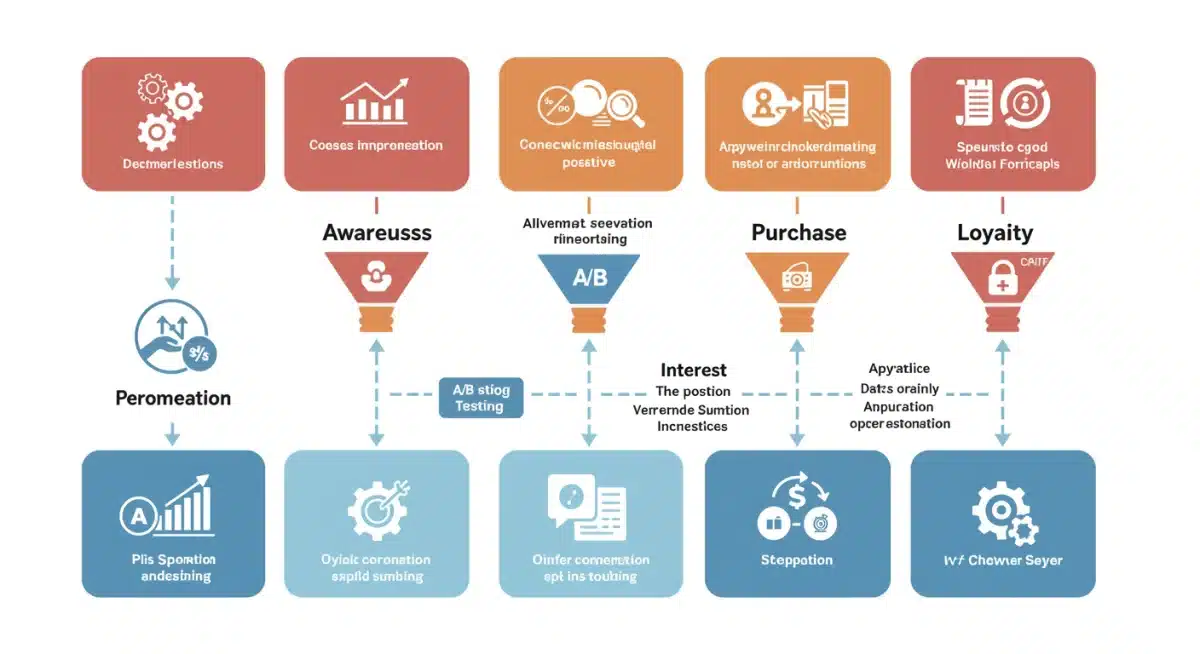
The e-commerce funnel represents the customer’s journey from initial awareness to final purchase. Each stage of this funnel presents unique opportunities for optimization through A/B testing, especially when informed by big data insights.
Understanding where customers drop off, what elements cause friction, and which touchpoints drive engagement is critical. Big data provides the visibility needed to pinpoint these areas, allowing for targeted A/B tests that address specific pain points within the funnel.
Targeted Testing Across Funnel Stages
Different stages of the e-commerce funnel require different testing strategies. For instance, the top of the funnel might focus on optimizing landing page copy and imagery to attract attention, while the checkout stage demands friction reduction and trust-building elements.
Big data helps identify which stages are underperforming for specific customer segments. This allows for a more strategic allocation of testing resources, ensuring that efforts are focused on areas with the greatest potential for improvement. For example, if data shows a high bounce rate from product pages for new visitors, A/B tests might focus on optimizing product descriptions or image galleries for this segment.
By applying A/B testing systematically across the entire funnel, e-commerce businesses can create a seamless and highly converting customer journey. This holistic approach ensures that improvements at one stage don’t inadvertently create new issues at another.
Challenges and Best Practices for 2025
While the combination of A/B testing and big data offers immense potential, it also comes with its own set of challenges. Data privacy concerns, the complexity of data integration, and the need for skilled analysts are among the hurdles businesses must overcome.
However, by adopting best practices and leveraging emerging technologies, e-commerce platforms can navigate these challenges effectively. The key lies in building a robust data infrastructure and fostering a data-driven culture.
Overcoming Data Complexity and Ensuring Privacy
Managing and interpreting vast amounts of data requires sophisticated tools and expertise. Beyond technical infrastructure, companies must also prioritize data privacy and compliance with regulations like GDPR and CCPA. Trust is paramount in data-driven marketing.
- Invest in Data Infrastructure: Implement scalable data warehousing and analytics platforms.
- Ensure Data Governance: Establish clear policies for data collection, storage, and usage.
- Prioritize Privacy by Design: Integrate privacy considerations into all data-related processes.
- Develop Analytical Talent: Train or hire data scientists and analysts skilled in A/B testing.
For 2025, the emphasis will be on ethical data usage and transparent practices. E-commerce businesses that master these aspects will not only gain a competitive edge but also build stronger, more trusting relationships with their customers.
The Future of A/B Testing: AI and Personalization
Looking ahead to 2025, the future of A/B testing in e-commerce is deeply intertwined with artificial intelligence (AI) and hyper-personalization. AI-powered testing platforms are already emerging, capable of running thousands of simultaneous experiments and dynamically optimizing experiences for individual users.
Instead of manual hypothesis formulation and variant creation, AI can automatically identify optimization opportunities, generate test variations, and even deploy winning solutions without human intervention. This level of automation significantly accelerates the optimization cycle.
AI-Driven Experimentation and Dynamic Personalization
AI algorithms can analyze customer behavior in real-time and serve personalized versions of web pages or product recommendations based on individual preferences and past interactions. This moves beyond traditional A/B testing to continuous, adaptive optimization.
The goal is to create a unique and highly relevant experience for every single user, maximizing engagement and conversion potential. This approach, often referred to as ‘MVT’ (Multivariate Testing) at scale, or ‘continuous optimization,’ represents the pinnacle of data-driven marketing.
The combination of AI and A/B testing will allow e-commerce businesses to move from reactive optimization to proactive, predictive personalization, ensuring that every customer interaction is optimized for maximum impact. This shift will redefine how e-commerce funnels are designed and managed.
Measuring Success and Proving ROI
Ultimately, the success of any A/B testing program, especially one integrated with big data, hinges on its ability to demonstrate a clear return on investment (ROI). This requires meticulous tracking of key performance indicators (KPIs) and a clear understanding of how testing impacts the bottom line.
Beyond simple conversion rates, businesses need to consider metrics like average order value (AOV), customer lifetime value (CLTV), and customer acquisition cost (CAC). Big data allows for a more comprehensive attribution of value from A/B test wins.
Key Metrics and Attribution Models
Establishing clear KPIs before launching any A/B test is crucial. These metrics should directly align with business objectives, whether that’s increasing sales, reducing bounce rates, or improving customer engagement.
Furthermore, big data enables more sophisticated attribution models. Instead of crediting the last touchpoint, businesses can understand the cumulative impact of various interactions and A/B test improvements across the entire customer journey. This provides a more accurate picture of ROI.
- Conversion Rate: The most direct measure of an A/B test’s impact on desired actions.
- Average Order Value (AOV): Indicates if tests are encouraging larger purchases.
- Customer Lifetime Value (CLTV): Measures the long-term value of customers acquired or retained through optimized funnels.
- Bounce Rate/Exit Rate: Identifies improvements in user engagement and friction reduction.
- Revenue Per Visitor (RPV): A holistic metric combining conversion and AOV.
By rigorously measuring and attributing the impact of A/B tests, e-commerce businesses can continuously refine their strategies, proving the tangible value of data-driven optimization efforts and securing ongoing investment in these critical activities.
| Key Aspect | Brief Description |
|---|---|
| Big Data Integration | Utilizing vast datasets for deeper insights, audience segmentation, and more precise A/B testing hypotheses. |
| Funnel Optimization | Applying A/B tests across all stages of the e-commerce funnel to identify and eliminate friction points. |
| AI and Personalization | Leveraging AI for automated experimentation and dynamic content delivery to individual users for hyper-personalization. |
| ROI Measurement | Rigorous tracking of KPIs and advanced attribution modeling to prove the tangible value of optimization efforts. |
Frequently Asked Questions About A/B Testing with Big Data
The primary benefit is unlocking deeper insights into customer behavior. Big data provides the context and granularity needed to formulate more precise hypotheses, segment audiences effectively, and conduct highly targeted A/B tests, leading to significantly more impactful optimizations and better conversion rates.
Big data helps by pinpointing exact drop-off points and friction areas within the funnel for different customer segments. This allows e-commerce businesses to focus A/B testing efforts on the most problematic stages, tailoring experiments to specific user groups and maximizing the potential for improvement in each segment.
Key challenges include managing the vast volume and variety of data, ensuring data privacy and compliance, integrating disparate data sources, and requiring specialized analytical skills. Overcoming these requires robust infrastructure, strong data governance, and continuous talent development.
By 2025, AI is expected to automate much of the A/B testing process, from hypothesis generation to variant deployment. It will enable continuous, dynamic optimization and hyper-personalization, delivering unique user experiences based on real-time behavior, moving beyond static A/B comparisons to adaptive optimization.
Beyond traditional conversion rates, crucial metrics include Average Order Value (AOV), Customer Lifetime Value (CLTV), and Revenue Per Visitor (RPV). Big data allows for more sophisticated attribution models to accurately trace the cumulative impact of A/B test wins across the entire customer journey, proving tangible ROI.
Conclusion
The journey to Mastering A/B Testing with Big Data: Optimizing E-commerce Funnels for 2025 Performance is not merely about running experiments; it’s about fostering a culture of continuous learning and adaptation. By integrating big data analytics into your A/B testing framework, e-commerce businesses can move beyond basic optimizations to achieve a truly personalized and highly efficient customer journey. The future of online retail belongs to those who can harness the power of data to understand, predict, and ultimately delight their customers, ensuring sustained growth and competitive advantage in an increasingly data-driven world.