Optimizing E-commerce Platform Performance for US Holiday Sales 2025

Achieving a 50% reduction in downtime for e-commerce platforms during US Holiday Sales 2025 demands comprehensive strategies encompassing robust infrastructure, proactive monitoring, and advanced performance optimization techniques.
The highly anticipated US Holiday Sales of 2025 are on the horizon, bringing with them both immense opportunity and significant challenges for e-commerce businesses. A critical objective for many is achieving a 50% reduction in downtime during US Holiday Sales of 2025, a goal that underscores the fierce competition and high customer expectations in today’s digital marketplace. Ensuring your platform can withstand the onslaught of traffic and transactions is not just about preventing lost sales; it’s about safeguarding brand reputation and fostering customer loyalty in an increasingly demanding landscape.
Understanding the stakes: why peak season performance matters
Peak seasons, particularly the US Holiday Sales period, represent the most critical revenue-generating windows for e-commerce businesses. The sheer volume of traffic and transactions can push even well-designed platforms to their limits, making performance optimization a non-negotiable priority. Downtime during these crucial periods can lead to substantial financial losses, erode customer trust, and provide competitors with an easy advantage.
The consequences of poor performance extend beyond immediate financial impacts. A slow or unresponsive website can deter potential customers, leading to abandoned carts and negative brand perception. In an era where online reviews and social media feedback heavily influence consumer choices, a single poor experience can have long-lasting repercussions. Therefore, a proactive and robust approach to platform performance is paramount for sustained success.
The cost of downtime during holiday sales
- Direct revenue loss: Every minute of downtime translates directly to missed sales opportunities, which can amount to millions of dollars for large retailers.
- Brand reputation damage: Customers often associate platform unreliability with a lack of professionalism, leading to a loss of trust and potentially long-term brand damage.
- SEO ranking impact: Search engines penalize slow or unavailable websites, affecting organic search visibility long after the peak season concludes.
The objective of a 50% reduction in downtime during the US Holiday Sales of 2025 is an ambitious yet achievable target for businesses committed to investing in their digital infrastructure. It requires a holistic strategy that addresses every facet of platform operation, from underlying architecture to front-end user experience. The focus must be on resilience, scalability, and efficiency to handle unpredictable traffic spikes.
Proactive load testing and capacity planning
One of the foundational steps in achieving superior e-commerce performance during peak seasons is rigorous load testing and meticulous capacity planning. This involves simulating extreme user traffic to identify bottlenecks and stress points in your system before they manifest as critical failures during live sales events. Without understanding your platform’s breaking point, you are essentially flying blind into the busiest shopping period of the year.
Effective load testing goes beyond simply checking if your server crashes. It involves analyzing response times, database performance, third-party API integrations, and the overall user experience under duress. This data is invaluable for making informed decisions about infrastructure upgrades, code optimizations, and resource allocation. The goal is not just to survive the peak, but to thrive, offering a smooth and enjoyable shopping journey for every customer.
Key aspects of effective load testing
- Realistic traffic simulation: Mimicking actual user behavior, including browsing patterns, cart additions, and checkout processes, is crucial for accurate testing.
- Scenario-based testing: Testing specific scenarios like flash sales, email marketing surges, or unexpected viral traffic helps prepare for diverse challenges.
- Third-party integration testing: Payment gateways, shipping APIs, and inventory management systems are common points of failure and must be thoroughly tested under load.
Capacity planning, informed by load testing results, allows businesses to provision the right amount of resources at the right time. This prevents over-provisioning, which can be costly, and under-provisioning, which leads to performance degradation and downtime. For the US Holiday Sales 2025, a dynamic and flexible capacity plan will be a key differentiator, enabling platforms to scale up and down efficiently in response to real-time demand fluctuations.
Implementing scalable cloud infrastructure
The modern e-commerce landscape demands agility and scalability, qualities best delivered by cloud-native architectures. Migrating to or optimizing existing cloud infrastructure is a critical strategy for businesses aiming for a 50% reduction in downtime during peak seasons. Cloud platforms offer unparalleled flexibility, allowing resources to be scaled almost instantaneously to match fluctuating demand, a capability physical servers struggle to provide.
Leveraging cloud services like auto-scaling groups, serverless functions, and managed databases can significantly enhance resilience and performance. These technologies automate the process of adding or removing resources based on traffic patterns, ensuring that your platform always has the capacity it needs without manual intervention. This not only reduces the risk of downtime but also optimizes operational costs by paying only for what you use.
Cloud infrastructure advantages for peak seasons
Cloud providers offer a suite of tools and services specifically designed for high-traffic applications. Utilizing these can dramatically improve your platform’s ability to handle the holiday rush. For instance, Content Delivery Networks (CDNs) distribute static assets like images and videos closer to users, reducing load times and server strain. Load balancers intelligently distribute incoming traffic across multiple servers, preventing any single point of failure from overwhelming the system.
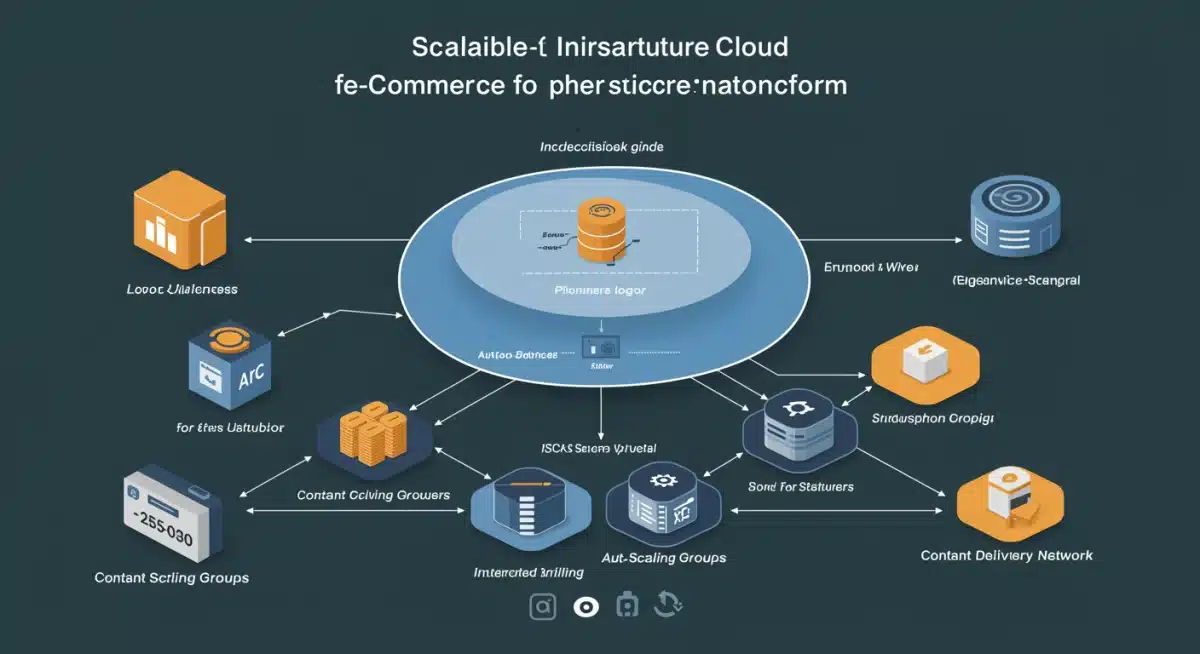
Furthermore, cloud environments facilitate disaster recovery and high availability. By deploying redundant systems across different geographical regions, businesses can ensure continuous operation even if one data center experiences an outage. This level of resilience is essential for meeting the stringent uptime targets required for the US Holiday Sales 2025.
Optimizing database performance and caching strategies
Databases are often the unsung heroes and, conversely, the silent killers of e-commerce performance. During peak seasons, an inefficient database can quickly become a bottleneck, slowing down every aspect of your platform. Optimizing database queries, indexing, and schema design are fundamental steps. However, to truly achieve a 50% reduction in downtime, advanced caching strategies are indispensable.
Caching stores frequently accessed data in a faster, more accessible location, reducing the need to hit the database for every request. This dramatically improves response times and reduces the load on your database servers, allowing them to handle a much higher volume of unique queries. Implementing multiple layers of caching, from client-side browser caching to server-side object caching and full-page caching, creates a robust defense against performance degradation.
Effective database and caching techniques
- Query optimization: Regularly review and optimize slow-running queries, ensuring they use appropriate indexes.
- Database scaling: Implement read replicas and sharding to distribute the database load and improve read/write performance.
- Object caching: Use in-memory caches like Redis or Memcached for frequently accessed data, session management, and product information.
- CDN integration: Leverage CDNs to cache static content and even dynamic content at the edge, reducing origin server load.
The combination of a well-optimized database and a multi-layered caching strategy forms a powerful defense against peak traffic challenges. It ensures that your platform can deliver content quickly and efficiently, even when thousands of users are simultaneously browsing, adding items to carts, and checking out. This proactive approach is vital for maintaining a smooth user experience and preventing performance-related downtime during the US Holiday Sales 2025.
Proactive monitoring and incident response
Even with the most meticulous planning and robust infrastructure, incidents can occur during peak seasons. The key to minimizing their impact and achieving a 50% reduction in downtime lies in proactive monitoring and a well-defined incident response plan. Real-time visibility into your platform’s health allows you to detect anomalies and potential issues before they escalate into full-blown outages, enabling swift and effective intervention.
Monitoring should encompass every layer of your e-commerce stack, from infrastructure metrics like CPU usage and network latency to application performance indicators (APIs) such as error rates, response times, and transaction success rates. Automated alerts, triggered by predefined thresholds, ensure that your team is immediately notified of any deviations from normal operation, allowing for rapid diagnosis and resolution.
Building a resilient incident response plan
An effective incident response plan should outline clear roles and responsibilities, communication protocols, and escalation paths. It’s not enough to simply detect an issue; your team must know exactly how to react. This includes having pre-approved rollback procedures, failover mechanisms, and contingency plans for various types of failures. Regular drills and post-mortem analyses of past incidents are crucial for continuous improvement.
For the US Holiday Sales 2025, having a dedicated ‘war room’ or incident management team on standby during critical periods can significantly reduce resolution times. This team should be empowered to make quick decisions and have access to all necessary tools and information to restore services promptly. The goal is to minimize the mean time to recovery (MTTR) and ensure that any disruption is as brief and imperceptible to the customer as possible.
Enhancing front-end performance and user experience
While backend infrastructure is crucial, the front-end experience directly impacts customer satisfaction and conversion rates. A slow-loading website, even if the backend is robust, can lead to high bounce rates and abandoned carts. Optimizing front-end performance is therefore an integral part of achieving a 50% reduction in downtime, as it reduces server load and improves overall responsiveness.
Techniques such as image optimization, code minification, and asynchronous loading of non-critical resources can dramatically improve page load times. Mobile-first design and progressive web apps (PWAs) are also essential, given the increasing prevalence of mobile shopping. A smooth and intuitive user interface not only delights customers but also indirectly contributes to platform stability by reducing unnecessary server requests and complex client-side processing.
The front-end is the direct interface with your customer, and any friction here can quickly translate into lost sales. Ensuring that your website is fast, responsive, and easy to navigate across all devices is a critical component of your peak season readiness strategy. This focus on user experience is not just about aesthetics; it’s a fundamental performance optimization that directly impacts your bottom line during the US Holiday Sales 2025.
Strategic partnerships and third-party reliability
E-commerce platforms rarely operate in isolation. They rely heavily on a network of third-party services, including payment gateways, shipping providers, analytics tools, and marketing platforms. The reliability of these external partners can significantly impact your platform’s overall performance and uptime during peak seasons. A single point of failure in a critical third-party service can bring your entire operation to a halt, regardless of your internal optimizations.
Establishing strong, reliable partnerships with vendors known for their robust infrastructure and high availability is paramount. It’s crucial to understand their peak season readiness plans, their Service Level Agreements (SLAs), and their historical performance during high-traffic events. Diversifying critical third-party providers, where feasible, can also mitigate risks, providing failover options if one service experiences issues.
Vendor assessment and contingency planning
- SLA review: Scrutinize SLAs for uptime guarantees, response times, and compensation for service disruptions.
- Performance history: Research and evaluate vendors’ performance during previous peak seasons and high-traffic events.
- Redundancy planning: Identify critical third-party services where a backup or alternative solution can be implemented.
- Communication protocols: Establish clear communication channels with vendors for proactive updates and rapid incident resolution.
For the US Holiday Sales 2025, a comprehensive assessment of all third-party dependencies is a non-negotiable step. This includes not only your primary payment processor but also your shipping API, CRM, and any other service that directly impacts the customer journey or core platform functionality. Proactive engagement with these partners, ensuring their readiness and understanding their contingency plans, is a vital layer of defense against potential downtime.
| Key Strategy | Brief Description |
|---|---|
| Load Testing | Simulate high traffic to identify and resolve performance bottlenecks before peak seasons. |
| Cloud Scaling | Utilize flexible cloud infrastructure for automatic resource scaling to meet demand. |
| Database & Caching | Optimize database queries and implement multi-layered caching for faster data retrieval. |
| Proactive Monitoring | Implement real-time monitoring and rapid incident response to minimize disruption. |
Frequently asked questions about peak season e-commerce performance
The primary goal is to ensure platform stability, speed, and availability during high-traffic periods, such as the US Holiday Sales, to prevent downtime, maximize sales, and maintain a positive customer experience. A key objective for many is a 50% reduction in downtime to protect revenue and brand image.
Load testing simulates extreme user traffic to identify system bottlenecks and vulnerabilities before live events. By proactively uncovering and addressing these issues, businesses can reinforce their infrastructure, optimize code, and prevent performance failures that lead to downtime during peak sales.
Cloud infrastructure offers unparalleled scalability and flexibility, allowing e-commerce platforms to automatically adjust resources to match fluctuating traffic demands. This dynamic scaling prevents overload and ensures continuous availability, significantly reducing the risk of downtime during events like holiday sales.
Caching stores frequently accessed data closer to the user or in faster memory, reducing the need for repeated database queries. This dramatically speeds up page load times and decreases the load on backend servers, making the platform more responsive and less prone to slowdowns or crashes under heavy traffic.
Businesses must vet third-party vendors for reliability, review their SLAs, and understand their peak season readiness. Establishing contingency plans, such as having backup providers or failover mechanisms for critical services, minimizes the risk of external dependencies causing platform downtime during crucial sales periods.
Conclusion
Achieving a 50% reduction in downtime during US Holiday Sales of 2025 is an ambitious yet entirely attainable goal for e-commerce businesses that prioritize comprehensive performance optimization. It demands a multi-faceted approach, integrating proactive strategies such as rigorous load testing, the adoption of scalable cloud infrastructure, and the meticulous optimization of databases and caching mechanisms. Coupled with robust, real-time monitoring and a well-drilled incident response plan, these technical pillars form the bedrock of a resilient e-commerce platform. Furthermore, acknowledging the critical role of external partners and ensuring their reliability is equally vital. By investing in these areas, businesses can not only safeguard their operations against the intense pressures of peak season but also transform potential challenges into opportunities for unparalleled customer satisfaction and significant revenue growth. The future of e-commerce success hinges on an unwavering commitment to performance excellence, ensuring that every click translates into a seamless and secure shopping experience.