BigCommerce 2025 Headless Features: 20% Faster US E-commerce
BigCommerce’s 2025 headless commerce features are poised to transform US e-commerce, delivering up to 20% faster page loads and robust flexibility by separating the customer-facing presentation layer from core backend operations.
The landscape of online retail is constantly evolving, with speed and flexibility becoming paramount for success. In this dynamic environment, BigCommerce’s 2025 headless commerce features are emerging as a game-changer, promising to unlock up to 20% faster page loads for US e-commerce platforms. This significant advancement addresses the critical need for speed and agility in delivering exceptional customer experiences, setting a new benchmark for performance and innovation in the digital storefront.
Understanding headless commerce and its impact
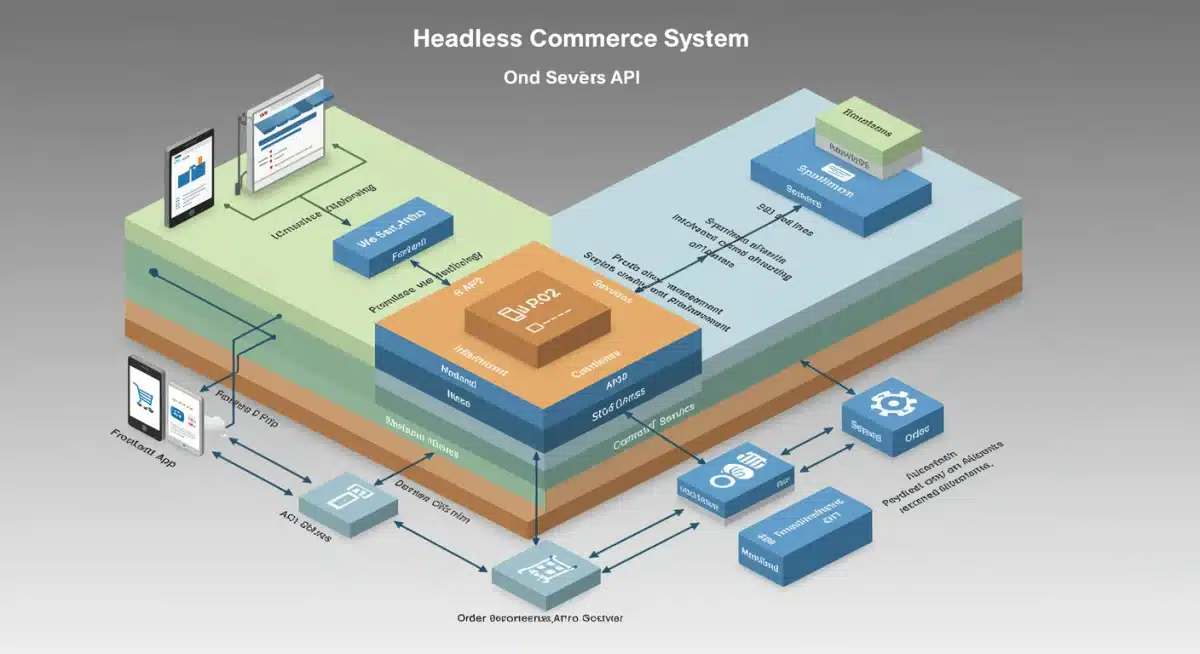
Headless commerce represents a fundamental shift in how e-commerce platforms are built and managed. Unlike traditional monolithic systems where the frontend (what customers see) and backend (where data and logic reside) are tightly integrated, headless architecture decouples these layers. This separation allows businesses to use any frontend technology they choose while leveraging a powerful e-commerce backend.
This architectural freedom brings immense benefits, particularly in terms of speed and customization. By separating the presentation layer, developers can build highly optimized, lightning-fast interfaces without being constrained by the backend’s limitations. This directly translates to quicker page loads, a crucial factor for user experience and search engine rankings. The ability to innovate rapidly on the frontend also means businesses can adapt to new trends and customer demands much faster.
The core principles of headless architecture
At its heart, headless commerce operates on the principle of APIs (Application Programming Interfaces). These APIs act as the communication bridge between the decoupled frontend and backend. Any data or functionality needed by the frontend is requested from the backend via these APIs. This modular approach allows for greater scalability and resilience.
- API-first approach: Every interaction, from product display to order processing, happens through robust APIs.
- Frontend flexibility: Businesses can utilize frameworks like React, Vue, or Next.js for highly customized user interfaces.
- Backend stability: Core commerce functions remain stable while the frontend evolves independently.
- Omnichannel readiness: Content can be delivered seamlessly across various touchpoints, including web, mobile, IoT devices, and even voice assistants.
The impact of headless commerce extends beyond just speed. It empowers brands to create truly unique and engaging shopping experiences. For US e-commerce platforms, this means a competitive edge in a crowded market, where every millisecond and every personalized interaction counts. Adopting headless is not just about technology; it’s about embracing a future-proof strategy for digital growth.
BigCommerce’s strategic investment in headless for 2025
BigCommerce has long been a proponent of open SaaS, and its roadmap for 2025 solidifies its commitment to headless commerce. The platform is strategically investing in features that enhance the headless experience, making it easier for businesses to leverage this architecture without sacrificing the robust functionality BigCommerce is known for. These investments are specifically targeted at improving performance, developer experience, and overall ecosystem integration.
The focus is on providing tools and integrations that reduce the complexity typically associated with headless implementations. For US e-commerce businesses, this means a lower barrier to entry for adopting a headless approach, allowing them to capitalize on faster page loads and greater flexibility sooner. BigCommerce aims to democratize headless commerce, making it accessible to a wider range of merchants, from mid-market to enterprise-level.
Key enhancements for developer experience
A significant portion of BigCommerce’s 2025 headless strategy revolves around improving the developer experience. This includes providing enhanced SDKs (Software Development Kits), more comprehensive API documentation, and pre-built integrations with popular frontend frameworks. By simplifying the development process, BigCommerce enables faster time-to-market for new features and optimizations.
- Improved API documentation: Clearer, more detailed guides for seamless integration.
- Headless-specific SDKs: Tools designed to accelerate frontend development.
- Pre-built connectors: Easier integration with popular CMS platforms and frontend frameworks.
- Enhanced developer tooling: Debugging and testing tools to streamline the development lifecycle.
These developer-centric improvements are crucial for unlocking the full potential of headless commerce. They ensure that businesses can build and maintain their custom frontends efficiently, maximizing the benefits of BigCommerce’s powerful backend. The goal is to empower developers to create cutting-edge shopping experiences that are both fast and visually appealing, without getting bogged down in complex backend integrations.
Achieving 20% faster page loads: the technical breakdown
The promise of up to 20% faster page loads is a bold claim, but it’s rooted in the fundamental advantages of headless architecture combined with BigCommerce’s specific optimizations. This speed increase is primarily achieved through several technical approaches, each contributing to a more streamlined and efficient delivery of content to the end-user. Understanding these mechanisms is key to appreciating the impact on user experience and conversion rates.
One of the main drivers is the ability to implement server-side rendering (SSR) or static site generation (SSG) with headless frontends. These techniques pre-render pages on the server or during the build process, delivering fully formed HTML to the browser. This drastically reduces the amount of work the browser has to do, leading to near-instantaneous page loads. Traditional platforms often rely heavily on client-side rendering, which can be slower.
Optimized content delivery networks (CDNs)
BigCommerce’s headless features also leverage advanced CDN strategies. By caching content closer to the end-user, CDNs significantly reduce latency and improve delivery speed. With a decoupled frontend, static assets like images, CSS, and JavaScript can be served even more efficiently, bypassing the backend entirely for many requests. This distributed network approach is vital for achieving global performance improvements.
- Edge caching: Storing content at network edge locations for faster retrieval.
- Asset optimization: Automatic compression and resizing of images and other media.
- Global network presence: Utilizing a vast network of servers to minimize distance to users.
- Intelligent routing: Directing user requests to the nearest and fastest server.
Furthermore, the lightweight nature of headless frontends means less JavaScript to download and execute, contributing to faster initial page paints and improved interactivity. BigCommerce’s focus on efficient API calls and optimized data payloads also minimizes the data transfer required between the frontend and backend. Together, these technical advancements create a powerful synergy that results in tangible speed improvements for US e-commerce platforms, directly impacting customer satisfaction and conversion rates.
Enhanced customer experience through speed and flexibility
The ultimate goal of faster page loads is to create a superior customer experience. In today’s fast-paced digital world, consumers expect instant gratification. A slow-loading website can lead to frustration, abandoned carts, and ultimately, lost sales. BigCommerce’s 2025 headless features directly address this by ensuring that online stores are not just functional, but exceptionally responsive and engaging.
Beyond speed, the flexibility offered by headless commerce allows for highly personalized and innovative shopping journeys. Businesses can integrate best-of-breed services, such as advanced recommendation engines, personalized content delivery systems, and sophisticated search functionalities, directly into their custom frontends. This creates a richer, more tailored experience for each customer, fostering loyalty and increasing engagement.
Personalization and dynamic content delivery
With a headless setup, dynamic content and personalization become much easier to implement and scale. The frontend can pull specific data points from the backend and other third-party services to display highly relevant product recommendations, localized promotions, or tailored content based on a customer’s browsing history and preferences. This level of customization is difficult to achieve with traditional monolithic platforms.
- A/B testing capabilities: Easily test different frontend designs and content variations.
- Localized experiences: Deliver region-specific content and pricing with ease.
- Seamless third-party integrations: Connect with marketing automation, CRM, and analytics tools.
- Interactive user interfaces: Build highly engaging elements that respond instantly to user input.
The ability to rapidly iterate on the frontend also means businesses can quickly respond to customer feedback and market trends, deploying new features and design updates without disrupting backend operations. This agility is invaluable for maintaining a competitive edge and continuously improving the customer journey. Ultimately, BigCommerce’s headless approach empowers brands to craft memorable and efficient online experiences that drive business growth.
Challenges and considerations for US e-commerce platforms
While the benefits of BigCommerce’s 2025 headless commerce features are compelling, US e-commerce platforms considering this transition must also be aware of the associated challenges and considerations. Adopting a headless architecture is a significant undertaking that requires careful planning, technical expertise, and a clear understanding of the long-term implications. It’s not a one-size-fits-all solution, and its suitability depends heavily on a business’s specific needs and resources.
One of the primary challenges is the increased complexity in terms of development and maintenance. With a decoupled system, businesses need dedicated frontend development resources and expertise to build and manage their custom interfaces. This often means a higher initial investment in development talent and infrastructure compared to off-the-shelf themes provided by monolithic platforms. However, the long-term benefits in flexibility and performance can often outweigh these initial costs.
Resource allocation and team expertise
A successful headless implementation requires a strong technical team with expertise in modern frontend frameworks, API integrations, and potentially content management systems (CMS) that are designed to work headlessly. Businesses may need to invest in training existing staff or hiring new talent to manage the new architecture effectively. This shift in resource allocation is a crucial factor in the decision-making process.
- Frontend development skills: Proficiency in JavaScript frameworks like React, Vue, or Next.js.
- API integration knowledge: Understanding how to consume and manage APIs effectively.
- DevOps considerations: Managing continuous integration and deployment for both frontend and backend.
- Content management strategy: Adapting to a headless CMS if not already in use.
Another consideration is the potential for increased vendor management. While BigCommerce provides the robust backend, businesses might integrate multiple third-party services for their custom frontend, such as a separate CMS, CDN, or analytics tools. Managing these various vendors and ensuring seamless integration requires a coordinated effort. However, this also allows for the selection of best-of-breed solutions for each specific need, leading to a more powerful and customized overall solution. Careful planning and a clear strategy are essential for navigating these complexities and maximizing the benefits of headless commerce.
The future of US e-commerce with BigCommerce headless
The trajectory for US e-commerce is undeniably towards more agile, performant, and personalized experiences, and BigCommerce’s 2025 headless commerce features are perfectly aligned with this future. The platform is positioning itself as a leader in providing the foundational technology that allows businesses to innovate without compromise. This means a future where online stores are not just transactional websites but dynamic, engaging digital showrooms that adapt instantly to customer needs and market shifts.
The emphasis on speed, exemplified by the promise of 20% faster page loads, is not merely a technical metric; it’s a direct investment in customer satisfaction and conversion. As competition intensifies, the ability to deliver seamless, instant experiences will be a critical differentiator for brands. BigCommerce’s headless capabilities empower businesses to build these next-generation experiences, ensuring they remain relevant and competitive in the evolving digital landscape.
Strategic advantages for competitive growth
For US e-commerce platforms, embracing BigCommerce’s headless features offers strategic advantages that go beyond immediate performance gains. It provides a robust framework for long-term growth and adaptability. Brands can experiment with new technologies, integrate emerging channels, and respond to consumer behavior changes with unparalleled speed. This agility fosters innovation and protects against technological obsolescence.
- Future-proofing: Adapting to new technologies and customer expectations with ease.
- Brand differentiation: Creating unique and memorable online shopping experiences.
- Scalability: Handling increased traffic and product catalog growth without performance degradation.
- Global reach: Delivering localized and optimized experiences across different markets.
The future will see even greater convergence of online and offline experiences, and headless commerce provides the architectural flexibility to support such integrations. Whether it’s connecting an online store to in-store kiosks, augmented reality applications, or voice commerce platforms, BigCommerce’s headless approach provides the underlying infrastructure. This holistic view of the customer journey, powered by speed and flexibility, will define success for US e-commerce platforms in 2025 and beyond.
| Key Feature | Benefit for US E-commerce |
|---|---|
| Decoupled Architecture | Enables independent frontend development for superior customization and speed. |
| Up to 20% Faster Page Loads | Boosts user engagement, reduces bounce rates, and improves conversion. |
| Enhanced Developer Tools | Streamlines development, allowing faster feature deployment and innovation. |
| Omnichannel Readiness | Supports consistent customer experiences across web, mobile, and emerging channels. |
Frequently asked questions about BigCommerce headless in 2025
Headless commerce is an e-commerce architecture where the frontend (customer-facing layer) is separated from the backend (logic and data). They communicate via APIs, allowing businesses to use any frontend technology for ultimate flexibility and faster experiences.
BigCommerce’s 2025 headless features enable faster page loads by supporting server-side rendering, static site generation, optimized CDN usage, and efficient API calls. This reduces browser workload and data transfer, leading to quicker content delivery.
While highly beneficial, headless commerce requires more technical resources and expertise. It’s particularly suitable for businesses needing extensive customization, omnichannel presence, and superior performance, often mid-market to enterprise-level, but BigCommerce aims to make it more accessible.
The main benefits include significantly faster page loads, enhanced customer experience, greater design flexibility, easier integration with best-of-breed services, and the ability to future-proof your e-commerce platform against evolving technological demands and consumer expectations.
Implementing a headless solution typically requires a team with strong frontend development skills (e.g., React, Vue), API integration knowledge, and potentially DevOps experience. Businesses might need to invest in training or hiring specialized talent to manage the decoupled architecture effectively.
Conclusion
BigCommerce’s strategic focus on headless commerce for 2025 marks a pivotal moment for US e-commerce platforms. The promise of unlocking up to 20% faster page loads represents more than just a technical improvement; it signifies a commitment to empowering businesses with the tools needed to thrive in a highly competitive digital landscape. By embracing a decoupled architecture, merchants can deliver unparalleled customer experiences, drive higher conversions, and maintain the agility required to innovate continuously. While considerations around resources and complexity remain, the long-term benefits of flexibility, speed, and strategic growth make BigCommerce’s headless features a compelling proposition for the future of online retail.