PWA Shift: US E-commerce Mobile Engagement Up 40% by 2025

Progressive Web Apps (PWAs) are poised to significantly boost mobile engagement in US e-commerce, with projections indicating a 40% increase by 2025 due to their enhanced performance and user-centric design.
The digital landscape for e-commerce is constantly evolving, and a pivotal transformation is underway with the shift to Progressive Web Apps (PWAs) on e-commerce platforms. This strategic move is not merely a trend but a foundational change, projected to drive a remarkable 40% increase in mobile engagement for US stores by 2025, reshaping how consumers interact with online retail.
The rise of PWAs in e-commerce
Progressive Web Apps are essentially websites that behave like native mobile applications, offering a seamless and engaging user experience without the need for a traditional app store download. Their emergence has been a game-changer for e-commerce, particularly in a mobile-first world where speed and accessibility are paramount.
As consumers increasingly rely on their smartphones for shopping, the limitations of traditional mobile websites, such as slow loading times and inconsistent performance, have become glaring. PWAs address these challenges directly, providing a solution that combines the best aspects of both web and native applications. This hybrid approach is proving to be incredibly effective in capturing and retaining mobile users.
Bridging the gap between web and native apps
One of the primary strengths of PWAs lies in their ability to offer app-like features through a web browser. This means businesses can deliver a rich user experience without the high development costs and maintenance associated with native applications. For consumers, it translates to instant access, faster interactions, and a more reliable shopping journey.
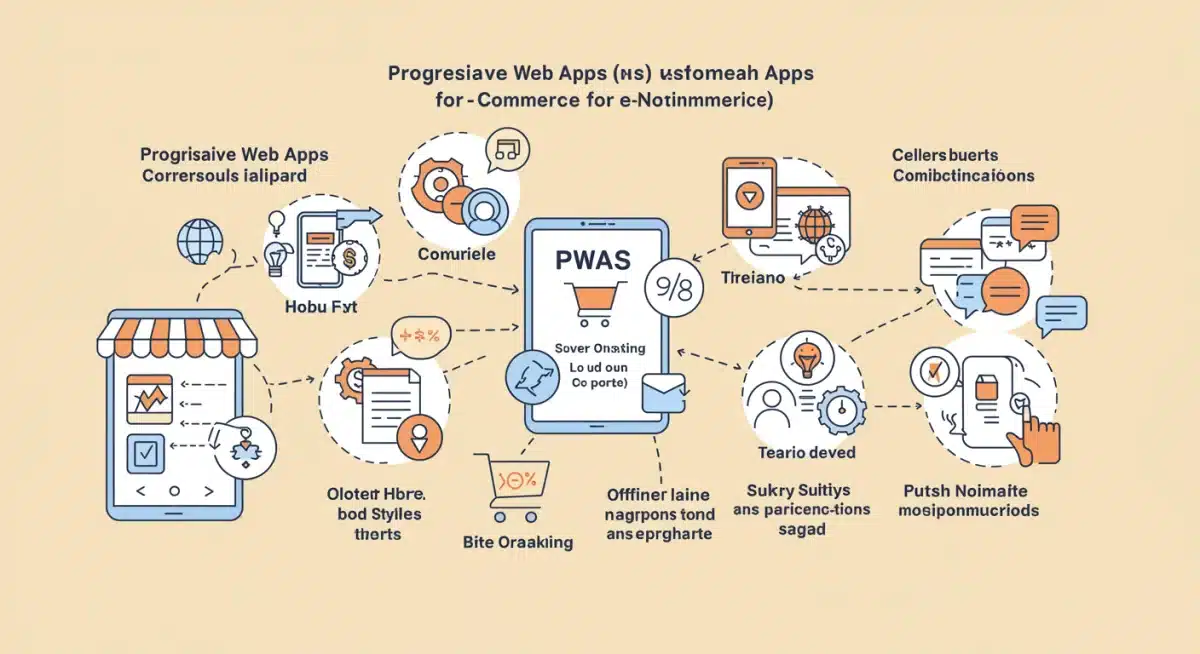
- Offline Capabilities: PWAs can function even without an internet connection, allowing users to browse products or access cached content.
- Push Notifications: They can send re-engagement notifications directly to users, similar to native apps, driving repeat visits and purchases.
- Home Screen Installation: Users can add PWAs to their device’s home screen, making them easily accessible with a single tap.
The adoption of PWAs signifies a strategic pivot for US e-commerce, recognizing the critical need to optimize mobile experiences. By leveraging PWA technology, online retailers are not just improving their websites; they are fundamentally enhancing their mobile presence, leading to higher engagement and conversion rates. This technological shift is a direct response to evolving consumer behaviors and expectations in the digital marketplace.
Enhanced mobile engagement: a closer look
The projected 40% increase in mobile engagement for US e-commerce by 2025 is a testament to the transformative power of Progressive Web Apps. This significant growth isn’t just about more clicks; it encompasses deeper interactions, longer session durations, and a higher likelihood of conversion. Understanding the mechanisms behind this enhancement is crucial for businesses looking to capitalize on this trend.
PWAs are designed from the ground up to prioritize user experience on mobile devices. They achieve this through a combination of technical optimizations and user-centric design principles. The result is a mobile shopping experience that feels intuitive, responsive, and incredibly efficient, which directly translates into increased engagement.
Key factors driving engagement growth
Several core features of PWAs contribute to their superior mobile engagement. These features address common pain points associated with traditional mobile websites and even some native applications, making the user journey smoother and more satisfying.
- Speed and Performance: PWAs load almost instantly, reducing bounce rates and ensuring users don’t get frustrated by slow pages.
- Reliability: Thanks to service workers, PWAs offer a consistent experience, even on unreliable networks, minimizing interruptions.
- Responsiveness: They adapt seamlessly to any screen size or orientation, providing an optimal viewing and interaction experience across all devices.
Beyond these technical advantages, the ability of PWAs to mimic native app functionalities, such as push notifications, plays a vital role in re-engaging users. These timely and personalized alerts can remind users about abandoned carts, new product arrivals, or special promotions, gently nudging them back to the store. This proactive approach to engagement is far more effective than passive waiting for users to return.
Ultimately, the enhanced mobile engagement driven by PWAs is a direct result of their ability to deliver a superior, friction-free experience. For e-commerce businesses, this means not only attracting more mobile users but also keeping them engaged for longer periods, fostering loyalty, and ultimately boosting sales.
Technical advantages of PWAs for retailers
For e-commerce retailers, the adoption of Progressive Web Apps offers a suite of compelling technical advantages that go beyond just improved user experience. These benefits translate directly into operational efficiencies, cost savings, and a stronger competitive position in the online marketplace. Understanding these technical underpinnings is key to appreciating the long-term value of PWA implementation.
One of the most significant advantages is the unified codebase. Unlike native apps, which require separate development for iOS and Android, PWAs are built using standard web technologies. This drastically reduces development time and resources, making them a more agile and cost-effective solution for businesses of all sizes.
Streamlined development and maintenance
The ability to develop once and deploy everywhere is a powerful proposition for retailers. Instead of managing multiple platforms, teams can focus their efforts on a single, highly optimized web application. This not only speeds up deployment but also simplifies ongoing maintenance and updates, ensuring a consistent experience across all devices.
- Lower Development Costs: Single codebase eliminates the need for separate iOS and Android app development.
- Faster Time to Market: Updates and new features can be rolled out instantly, without app store approval processes.
- Improved SEO: PWAs are discoverable by search engines, unlike native apps, enhancing organic reach.
Furthermore, PWAs leverage modern web capabilities like service workers for caching and background synchronization, significantly improving performance and reliability. This means faster page loads, smoother animations, and a more robust experience, even under challenging network conditions. These technical efficiencies directly contribute to a better user experience, which in turn drives higher engagement and conversion rates.
The technical robustness of PWAs positions them as a strategic asset for e-commerce retailers. They offer a future-proof solution that aligns with the evolving demands of mobile users while providing tangible benefits in terms of development, maintenance, and search engine visibility. This makes them an intelligent investment for any online business aiming for sustained growth and profitability.
Impact on conversion rates and revenue
While mobile engagement is a crucial metric, the ultimate goal for any e-commerce business is to drive conversions and increase revenue. Progressive Web Apps have consistently demonstrated a strong positive correlation with improved conversion rates, directly impacting the bottom line for retailers. This financial upside is a compelling reason for the widespread adoption of PWAs across the US e-commerce landscape.
The enhanced user experience offered by PWAs translates directly into a more efficient sales funnel. Faster loading times reduce friction, push notifications encourage re-engagement, and offline capabilities ensure a seamless journey even in challenging environments. Each of these elements works in concert to guide users more effectively towards a purchase.
Case studies and statistical evidence
Numerous companies that have implemented PWAs have reported significant improvements in their key performance indicators (KPIs). These real-world examples provide strong evidence of the financial benefits associated with this technology.
- Increased Conversions: Many businesses report double-digit percentage increases in conversion rates after launching a PWA.
- Higher Average Order Value (AOV): Improved user experience can lead to more confident purchasing decisions and larger basket sizes.
- Reduced Bounce Rates: Faster loading and reliable performance keep users on the site longer, exploring more products.
For instance, a major US online retailer implementing a PWA saw a substantial boost in mobile conversions and a noticeable reduction in cart abandonment rates. The ability to quickly load product pages and complete transactions without interruption proved invaluable. Moreover, the re-engagement through push notifications helped recover potentially lost sales, directly contributing to revenue growth.
The impact of PWAs on conversion rates and revenue is not merely anecdotal; it’s backed by empirical data from diverse e-commerce sectors. By removing barriers to purchase and fostering a more engaging shopping environment, PWAs are proving to be a powerful tool for unlocking significant financial gains for US e-commerce stores, reinforcing their position as a vital digital strategy.
Challenges and considerations for adoption
While the benefits of Progressive Web Apps for e-commerce are substantial, their adoption is not without its challenges and crucial considerations. Retailers looking to make the shift must approach implementation strategically, understanding the potential hurdles and planning for a smooth transition. Acknowledging these factors ensures a more successful and impactful deployment.
One primary challenge can be the initial development cost, especially for complex e-commerce platforms with extensive features. Although typically less expensive than native app development, building a robust PWA still requires skilled developers and a clear understanding of the platform’s unique requirements. This investment needs to be weighed against the projected long-term gains in engagement and revenue.
Overcoming implementation hurdles
Successfully integrating a PWA often involves re-architecting parts of an existing website or building a new front-end. This can be a significant undertaking, requiring careful planning and execution to avoid disrupting current operations or user experience during the transition period.
- Browser Support Variations: While widely supported, some PWA features might behave differently across various browsers, requiring thorough testing.
- Feature Parity with Native Apps: Achieving full feature parity with a highly complex native app might be challenging for some specific functionalities.
- User Education: Informing users about the benefits of adding a PWA to their home screen can sometimes be a hurdle, requiring clear communication.
Another consideration is the ongoing maintenance and optimization. Like any advanced web application, PWAs require continuous monitoring, updates, and performance tuning to ensure they remain fast, secure, and compatible with evolving web standards. Retailers must allocate resources for this ongoing effort to maximize the PWA’s effectiveness.
Despite these challenges, the overwhelming evidence points to PWAs as a worthwhile investment. By carefully planning the implementation, addressing potential technical complexities, and focusing on user education, e-commerce businesses can successfully navigate the adoption process and fully realize the transformative benefits that PWAs offer in terms of mobile engagement and profitability.
Future outlook: PWAs shaping e-commerce
The trajectory of Progressive Web Apps in e-commerce indicates not just a temporary trend but a fundamental shift in how online retail will operate in the coming years. As technology continues to evolve and consumer expectations for mobile experiences grow, PWAs are poised to play an even more central role, shaping the future of digital shopping.
The projected 40% increase in mobile engagement by 2025 is likely just the beginning. As more businesses adopt PWAs and users become accustomed to their benefits, the bar for mobile e-commerce experiences will be raised. This will create a competitive environment where PWAs become a standard rather than a differentiator, pushing innovation further.
Innovations and evolving capabilities
The PWA ecosystem itself is constantly evolving, with new capabilities and features being introduced regularly. This continuous innovation ensures that PWAs will remain at the forefront of mobile web technology, offering even more sophisticated tools for e-commerce businesses.
- Deeper Hardware Integration: Future PWAs may offer even richer integrations with device hardware, expanding their functionality.
- Enhanced AI and Personalization: The ability to deliver highly personalized experiences through PWAs will become even more sophisticated.
- Broader Platform Support: As PWA standards mature, their performance and feature set will become even more consistent across all platforms.
Furthermore, the increasing focus on sustainable web development and reducing data consumption aligns perfectly with the lightweight and efficient nature of PWAs. This makes them not just a user-friendly choice but also an environmentally conscious one, appealing to a growing segment of consumers.
The future of e-commerce is undeniably mobile-centric, and PWAs are perfectly positioned to lead this charge. Their ability to deliver fast, reliable, and engaging experiences, coupled with their continuous evolution, ensures that they will remain a cornerstone of successful online retail strategies, driving significant growth and innovation across the US market and beyond.
| Key Aspect | Description |
|---|---|
| Mobile Engagement Boost | US e-commerce expects a 40% increase by 2025 due to PWA adoption, driven by superior user experience. |
| PWA Core Benefits | Fast loading, offline capability, push notifications, and home screen installation enhance user interaction. |
| Retailer Advantages | Lower development costs, faster time to market, and improved SEO compared to native apps. |
| Conversion & Revenue | PWAs lead to higher conversion rates, increased average order value, and reduced bounce rates. |
Frequently asked questions about PWAs in e-commerce
A PWA is a type of web application that offers capabilities traditionally only available to native applications, such as offline access, push notifications, and home screen installation. It delivers an app-like experience directly through a web browser, combining the best of both worlds for users and developers.
PWAs boost engagement through rapid loading times, reliable performance even with poor network conditions, and interactive features like push notifications. This creates a smoother, more satisfying user experience that encourages longer sessions and repeat visits, mirroring native app convenience.
While an initial investment is required, PWAs are generally more cost-effective than developing separate native iOS and Android applications. Their single codebase streamlines development and maintenance, reducing long-term expenses and offering a faster time to market for updates and new features.
For many e-commerce businesses, PWAs can effectively replace or complement native apps, especially for core functionalities. They offer a highly capable alternative that bypasses app store friction and provides excellent user experience. However, some highly specialized native app features might still require a dedicated app.
PWAs are inherently discoverable by search engines, unlike native apps, meaning their content can be indexed and ranked. This improves organic visibility and traffic. Additionally, their fast loading speeds and superior user experience are positive ranking signals for search engines, further enhancing SEO performance.
Conclusion
The projected 40% increase in mobile engagement for US e-commerce by 2025, driven by the adoption of Progressive Web Apps, underscores a significant and irreversible shift in the digital retail landscape. PWAs offer a compelling blend of web accessibility and app-like functionality, addressing critical consumer demands for speed, reliability, and an engaging mobile experience. For online retailers, embracing this technology is not merely an upgrade but a strategic imperative to remain competitive, foster customer loyalty, and ultimately unlock substantial growth in an increasingly mobile-first world.