From Zero to 10,000 Orders: US E-commerce Fulfillment 2025
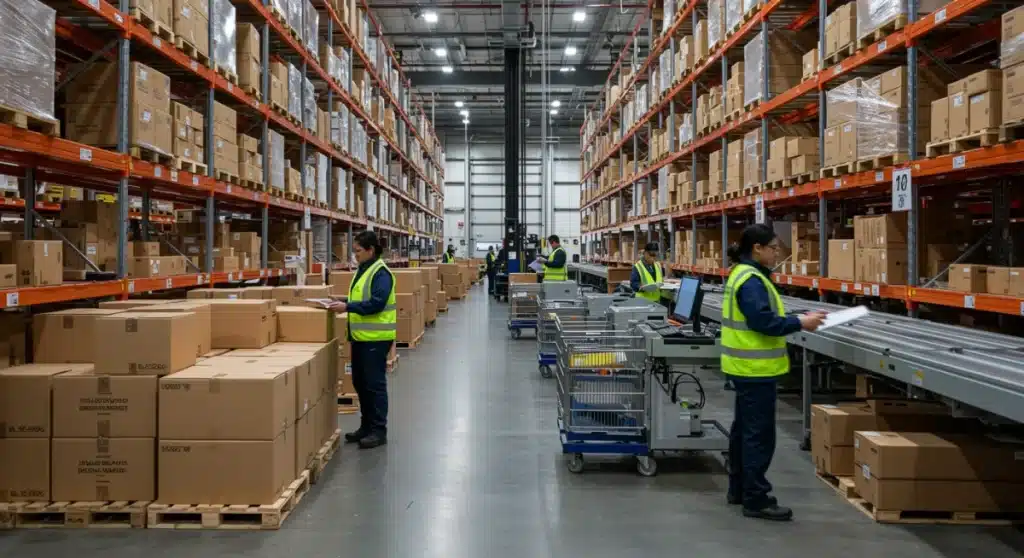
Achieving rapid growth from zero to 10,000 orders in six months for a US e-commerce business in 2025 requires strategic planning, efficient fulfillment, and adaptable logistics solutions to meet escalating customer demands.
Imagine launching an e-commerce venture today and, just six months later, celebrating your 10,000th order. This might sound like an ambitious dream, but with the right strategies and a keen understanding of the evolving landscape of US e-commerce fulfillment, it’s an achievable reality for 2025. This article delves into the critical steps and innovative approaches that can turn such a bold vision into a tangible success story.
The foundation: strategic market entry and product validation
Embarking on an e-commerce journey demands more than just a great product; it requires a meticulously planned market entry. Before aiming for 10,000 orders, businesses must ensure their product resonates deeply with the target audience and that the market is ripe for disruption. This initial phase is about groundwork, understanding consumer needs, and validating demand to minimize risks.
Product validation is a continuous process, not a one-time event. It involves testing, gathering feedback, and iterating rapidly. Successful e-commerce stories often begin with a deep dive into niche markets, identifying underserved customer segments, and crafting solutions that genuinely solve their problems. This focused approach allows for a more targeted marketing effort and a stronger initial customer base.
Identifying your niche and target audience
- Conduct thorough market research to pinpoint gaps.
- Analyze competitor offerings and identify areas for differentiation.
- Create detailed buyer personas to understand customer needs.
Once the niche is defined, the product must be refined to meet specific demands. This includes not only the product’s features but also its pricing, branding, and overall value proposition. A clear value proposition is essential for standing out in a crowded digital marketplace and attracting early adopters who can become brand advocates.
Building an agile supply chain from day one
Rapid scalability in e-commerce hinges on an agile and robust supply chain. For a business aiming for 10,000 orders in six months, traditional supply chain models are often too slow and inflexible. The focus must be on creating a system that can adapt to sudden spikes in demand, manage inventory efficiently, and ensure timely delivery.
This means carefully selecting suppliers, negotiating favorable terms, and establishing clear communication channels. Diversifying suppliers can mitigate risks associated with single-source dependencies, ensuring that production can continue even if one supplier faces disruptions. Automation and technology play a pivotal role in optimizing this process, from order placement to inventory tracking.
Key components of an agile supply chain
- Diversified supplier network for redundancy and flexibility.
- Robust inventory management systems to prevent stockouts and overstocking.
- Real-time data analytics for demand forecasting and supply chain optimization.
An agile supply chain also considers the geographical distribution of inventory. Placing goods closer to customers, especially in a vast market like the US, significantly reduces shipping times and costs, which are crucial for customer satisfaction and competitive advantage. This foresight in logistics planning is a cornerstone of rapid growth.
Leveraging technology for efficient fulfillment in 2025
The year 2025 brings with it advanced technological solutions that are transforming e-commerce fulfillment. From automated warehouses to AI-driven logistics, businesses have an unprecedented opportunity to optimize their operations. The goal is to minimize human error, reduce processing times, and enhance overall efficiency, all while maintaining cost-effectiveness.
Integrating a powerful Order Management System (OMS) and Warehouse Management System (WMS) is non-negotiable for scaling. These systems provide centralized control over inventory, orders, and shipping, offering real-time visibility and enabling data-driven decisions. Furthermore, innovative solutions like robotic process automation (RPA) can handle repetitive tasks, freeing up human resources for more complex activities.
Technological advancements in fulfillment
- AI-powered demand forecasting to optimize inventory levels.
- Robotics and automation in picking and packing processes.
- Advanced analytics for route optimization and delivery efficiency.
Embracing these technologies from the outset provides a significant competitive edge. It allows businesses to handle a larger volume of orders with fewer resources, ensuring that the fulfillment operation can scale seamlessly with increasing demand. The investment in technology pays dividends in efficiency, accuracy, and customer satisfaction.
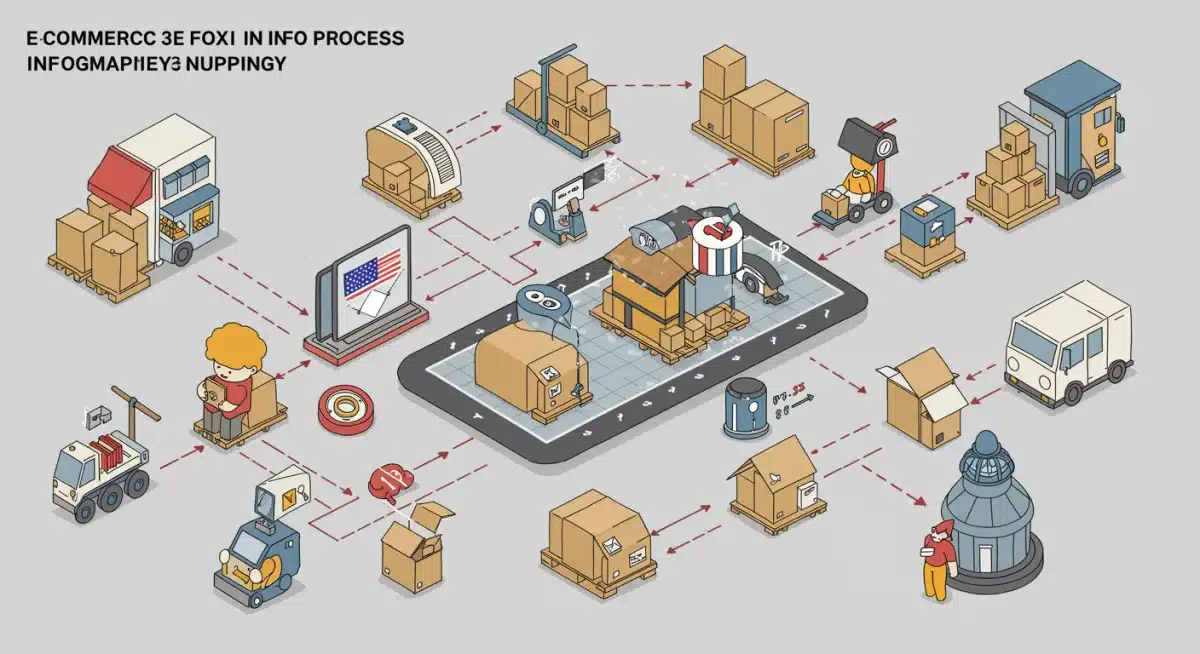
The crucial role of third-party logistics (3PL) providers
For many e-commerce businesses aiming for rapid growth, partnering with a Third-Party Logistics (3PL) provider is not just an option but a strategic imperative. A reliable 3PL can offer expertise, infrastructure, and scalability that would be prohibitively expensive to build in-house, especially when starting from zero.
Choosing the right 3PL is critical. It involves evaluating their capabilities, technology stack, geographical footprint, and their ability to integrate seamlessly with your e-commerce platform. A good 3PL partner can handle everything from warehousing and inventory management to picking, packing, and shipping, allowing the e-commerce business to focus on product development and marketing.
The benefits of a 3PL extend beyond operational efficiency. They often have established relationships with carriers, leading to better shipping rates and faster transit times. This is particularly important for businesses operating in the US market, where customer expectations for quick delivery are high. A well-chosen 3PL can significantly enhance the customer experience.
Optimizing shipping and delivery for the US market
In the US e-commerce landscape, shipping and delivery are not merely logistical functions; they are integral parts of the customer experience. Fast, reliable, and affordable shipping can be a major differentiator. To achieve 10,000 orders in six months, businesses must meticulously optimize their shipping strategies.
This includes understanding various shipping options, negotiating rates with carriers, and offering transparent shipping information to customers. Implementing strategies like free shipping for orders above a certain value, expedited shipping options, and clear return policies can significantly boost conversion rates and customer loyalty. The rise of same-day and next-day delivery expectations, particularly in urban areas, further emphasizes the need for efficient logistics.
Strategies for optimized shipping
- Leverage multiple shipping carriers for diverse service levels and cost-effectiveness.
- Implement dynamic shipping rates based on location and order value.
- Offer clear tracking information and proactive communication regarding delivery status.
Geographical proximity to customers through distributed warehousing or strategically located fulfillment centers, often managed by a 3PL, is vital. This reduces transit times and shipping costs, enabling businesses to compete effectively with larger players. The goal is to turn shipping from a potential obstacle into a competitive advantage.
Customer experience: the ultimate growth driver
While efficient fulfillment and robust logistics are foundational, the ultimate driver for reaching 10,000 orders and beyond is an exceptional customer experience. Every touchpoint, from the initial website visit to post-delivery support, contributes to how customers perceive the brand. In the highly competitive e-commerce space, positive experiences lead to repeat purchases and word-of-mouth referrals.
This includes a user-friendly website, clear product descriptions, responsive customer service, and hassle-free returns. Personalized marketing efforts, loyalty programs, and actively soliciting customer feedback also play a significant role. When customers feel valued and supported, they are more likely to become loyal advocates, fueling organic growth.
For a business scaling rapidly, maintaining high standards of customer service can be challenging but is absolutely essential. Investing in customer service tools and training, and empowering support teams to resolve issues quickly and effectively, can prevent negative experiences from derailing growth. The aim is to create a seamless and enjoyable journey for every customer.
Data-driven decision making and continuous improvement
The path to 10,000 orders in six months is not linear; it involves constant adaptation and refinement. Data-driven decision-making is paramount for identifying what works, what doesn’t, and where improvements can be made. This means collecting and analyzing data across all aspects of the business, from marketing campaigns to fulfillment metrics.
Key performance indicators (KPIs) such as conversion rates, average order value, customer acquisition cost, shipping times, and return rates must be continuously monitored. Regular analysis of this data provides actionable insights, allowing businesses to optimize their strategies, allocate resources effectively, and proactively address potential issues. Continuous improvement is not just a philosophy; it’s a practical necessity for rapid scaling.
Essential KPIs for rapid growth
- Conversion Rate: Percentage of website visitors who make a purchase.
- Customer Lifetime Value (CLV): Total revenue expected from a customer.
- Order Accuracy Rate: Percentage of orders fulfilled without errors.
- On-Time Delivery Rate: Percentage of orders delivered within the promised timeframe.
By embracing a culture of continuous learning and iteration, e-commerce businesses can quickly adapt to market changes, overcome challenges, and sustain their growth momentum. This agile approach, backed by solid data, is what transforms ambitious goals into tangible successes in the dynamic US e-commerce landscape.
| Key Aspect | Brief Description |
|---|---|
| Strategic Market Entry | Validate product-market fit and identify niche opportunities for targeted growth. |
| Agile Supply Chain | Build flexible logistics, diversify suppliers, and manage inventory efficiently to scale. |
| Tech-Driven Fulfillment | Utilize OMS, WMS, AI, and automation for optimized operations and reduced errors. |
| 3PL Partnership | Leverage third-party logistics for infrastructure, expertise, and scalability benefits. |
Frequently asked questions about US e-commerce fulfillment in 2025
The most critical factor is a highly efficient and scalable fulfillment strategy. This includes robust inventory management, optimized shipping, and potentially leveraging third-party logistics (3PL) providers to handle increasing order volumes without compromising speed or accuracy.
New businesses can compete by focusing on niche markets, offering superior product differentiation, and providing an exceptional customer experience. Leveraging agile fulfillment solutions, including 3PLs, helps reduce operational costs and improve delivery times, matching larger competitors’ capabilities.
Technology is fundamental. Implementing advanced Order Management Systems (OMS), Warehouse Management Systems (WMS), and leveraging AI for demand forecasting and automation in packing significantly boosts efficiency, reduces errors, and enables seamless scalability to handle high order volumes.
For aggressive growth targets like 10,000 orders in six months, partnering with a 3PL is often essential. They provide the necessary infrastructure, expertise, and scalability, allowing the e-commerce business to focus on core activities like marketing and product development, rather than logistics complexities.
Customer experience is paramount. Positive experiences drive repeat purchases and word-of-mouth referrals, which are crucial for rapid scaling. This includes user-friendly websites, transparent shipping, responsive customer service, and efficient handling of returns, all contributing to brand loyalty.
Conclusion
Achieving the ambitious goal of scaling from zero to 10,000 orders in just six months for a US e-commerce business in 2025 is a testament to strategic planning, technological adoption, and an unwavering focus on customer satisfaction. It’s a journey that demands a deep understanding of the market, the establishment of an agile supply chain, and the intelligent leveraging of fulfillment partners and advanced technologies. By meticulously executing these strategies, new e-commerce ventures can not only meet but exceed their growth expectations, solidifying their presence in a competitive digital landscape.